
December 15, 2025 | By Hannah Cheever and Victoria Schaefer

Almost two thirds of students report experiencing at least one potentially traumatic event during their school-age years, and supportive adults in communities and schools can work together to build students’ resiliency.
Handle With Care (HWC) is a school–community partnership model, created by the West Virginia Center for Children’s Justice (WVCCJ) in 2013, to help mitigate the impact of potentially traumatic events on students.
HWC is a simple model – a notification from law enforcement to schools whenever a school-age child is present at the scene of an incident. This notification allows school staff to better identify students who may need additional support and help ensure they succeed in school.
HWC Model
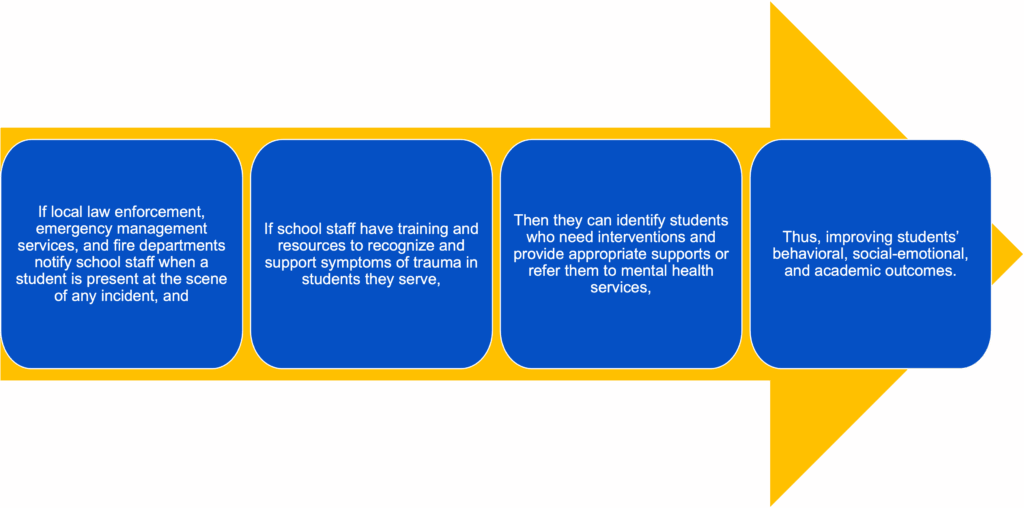
HWC grew in popularity quickly, as it is a freely available program and leaders from WVCCJ shared information about the program at national and state conferences.
In the last decade, law enforcement and education leaders across more than 40 states have implemented policies to bring HWC to their regions. These policies include statewide implementation, as in Kentucky and Maryland, and guides on how to set up a notification system at the regional and district levels, among other policies.
West Virginia state leaders partnered with SRI to leverage this growing momentum around HWC to strengthen the program by integrating evidence-based practices (EBPs) and studying program effectiveness.
Integrating Data Use and EBPs into the HWC Model
SRI has continued to work with local partners in West Virigina to build a more robust, evidence-based infrastructure of materials, tools, and technical support. This work included a project as part of SRI’s Regional Educational Laboratory Appalachia as well as two additional U.S. Department of Justice grants to build infrastructure and integrate evidence-based practices into HWC.
Through these projects, the SRI team worked in partnership with local leaders to address the pressing need for more intentional data use and more evidence-based support for students around the HWC notification process. Specifically, practitioners were interested in more systematic tracking of the data around HWC notices to inform ongoing program improvements.
By looking at data for students who have an HWC notice, school staff can more fully understand how program implementation relates to student outcomes like behavior, attendance, and achievement, as well as what areas of implementation need improvement. Practitioners were also interested in educator training on what steps to take upon receipt of an HWC notice and how to improve support for students using EBPs.
SRI and partners created an enhanced Handle With Care 2.0 model, transforming the notification program into a larger intervention, with technical support.
Enhancing the HWC Model
The enhanced HWC 2.0 model aims to build lasting partnerships between schools, law enforcement, mental health services, and other community organizations; train educators to improve school climate through routinized trauma-sensitive practices; and coach small school teams to monitor data for ongoing improvement. To achieve these aims, SRI staff provide the following technical support to participating schools:
- Tools, materials, and coaching to drive data use for ongoing improvement.
Each participating school forms a small team, or leverages an existing one, dedicated to reviewing program implementation data regularly throughout the school year. The school team identifies areas to improve and, together with school leaders, takes action to strengthen implementation.
- Educator training to improve understanding of trauma and its impacts, including current neuroscience and research on well-being.
School staff receive training to improve their understanding of trauma-sensitive and learner-centered practices that better meet students’ needs. Training options include synchronous and asynchronous learning opportunities, with content delivery based on district culture.
See an example handout from the training.
- Support to recruit, create, facilitate, and sustain a partnership between schools, law enforcement and first responders, mental health services, and other community organizations. A designated lead, supported by SRI, builds a sustainable partnership. Members identify and share relevant public information with one another during meetings, building a shared awareness of activities in the community that impact the student population. Members receive supportive materials such as recruitment flyers, meeting presentation templates, and a standard agenda.
Building the Evidence Base for HWC
As part of HWC 2.0, SRI and WVCCJ worked with West Virginia’s Berkeley County Schools to implement HWC in six Berkeley County schools and evaluate the program.
The evaluation team looked at how local first responder organizations and school personnel implemented HWC 2.0 and how HWC 2.0 might be related to school climate, school staff’s belief in their ability to support students (particularly those impacted by trauma), and student behavioral and academic outcomes.
Compared with staff in similar schools not participating in HWC 2.0, staff in HWC 2.0 schools reported higher ratings of school climate and schoolwide support for the use of trauma-sensitive practices as well as greater knowledge about trauma, confidence in using trauma-sensitive practices, and use of trauma-sensitive practices.
While the evaluation did not find differences in student outcomes within the one-year study, these evaluation findings suggest HWC 2.0 has a meaningful impact on school climate and staff efficacy of implementing trauma-sensitive support.
Looking Ahead: Sustainability and Scale
SRI and our partners are continuing to work to scale and enhance the HWC 2.0 model to make it business-as-usual for any school, district, and state implementing the program. We are doing this by:
- Continuing to leverage growing momentum around HWC. There continues to be state and national support, and aligned infrastructure, to expand the HWC 2.0 model. At the national level, there are an annual HWC conference and resource hubs. More and more states are codifying HWC into their policies and creating statewide support structures.
- Enhancing the usability and sustainability of the model. To ensure schools and districts can easily implement the HWC 2.0 model, we are enhancing the convenience and cost of the model by identifying the core components that need to be implemented with fidelity. Although at its core HWC is a free notification program, we are also working on reducing the cost of the additional supports as well as the time and resources to implement the model. For the educator training on how to support students experiencing trauma, for example, we are creating eight one-page handouts to accompany the training videos, envisioning a condensed version that provides quick-reference guides for critical content.
- Positioning HWC for broader market success. We plan to share materials freely with others around the nation who are interested in implementing the more robust HWC 2.0 in their school communities. A web presence will facilitate information-sharing and build awareness of the program and availability of implementation support. By building more awareness of the HWC model—and its efficacy—we can drive further interest and adoption.
Learn more about Handle With Care 2.0 on the SRI website.