
October 7, 2025 | By the LEARN Network
The LEARN to Scale Toolkit offers a roadmap for education product developers to design innovations that can reach more districts, schools, and learners. Built around the Invent-Apply-Transition (I-A-T) framework, the toolkit helps research and development (R&D) teams test, refine, and prepare evidence-based products for scale. But when you’re in the thick of development, the path forward isn’t always clear.
Maybe you’ve already done some work and aren’t sure where to enter the I-A-T process. Maybe you’re mid-cycle, deciding whether to move forward or revisit an earlier step. Or maybe you’re deep into testing and wondering if your product is finally ready to scale.
Wherever you are, it helps to know your next step.
From Framework to Toolkit
The LEARN to Scale Toolkit helps researchers and developers bridge the gap between evidence and widespread use. Adapted from a framework used by SRI to scale innovations in health care, software, and robotics, it offers clear, proven strategies tailored specifically for the education market.
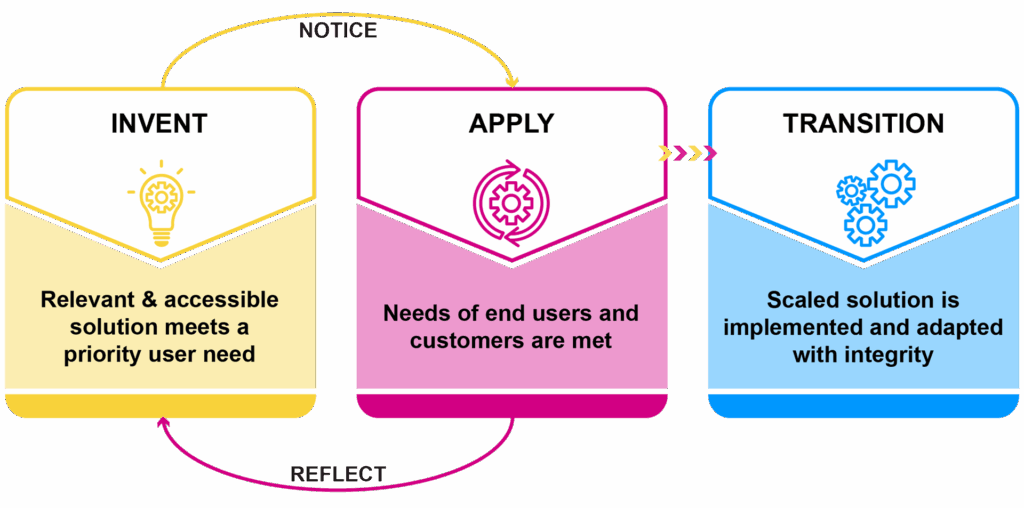
The I-A-T framework is simple but powerful, breaking the development and scaling process into three stages:
- Invent focuses on understanding user needs and creating a promising solution.
- Apply centers on testing, refining, and demonstrating product–market fit.
- Transition emphasizes scaling and sustainability.
As seen in the graphic below, Invent and Apply are intentionally iterative; teams learn what works, refine, and cycle back until they’re ready to move into Transition, where products can scale with integrity.
The LEARN to Scale Toolkit builds on this structure with tools that help teams move intentionally through each stage. It emphasizes strategies such as mapping stakeholders, engaging end-users as co-designers, and identifying the policy and system conditions that support adoption. Because teams may join the I-A-T process at different stages, the toolkit offers multiple points of entry, supporting R&D teams whether they are starting out, refining an existing product, or preparing to scale.
Introducing the I-A-T Decision Tree
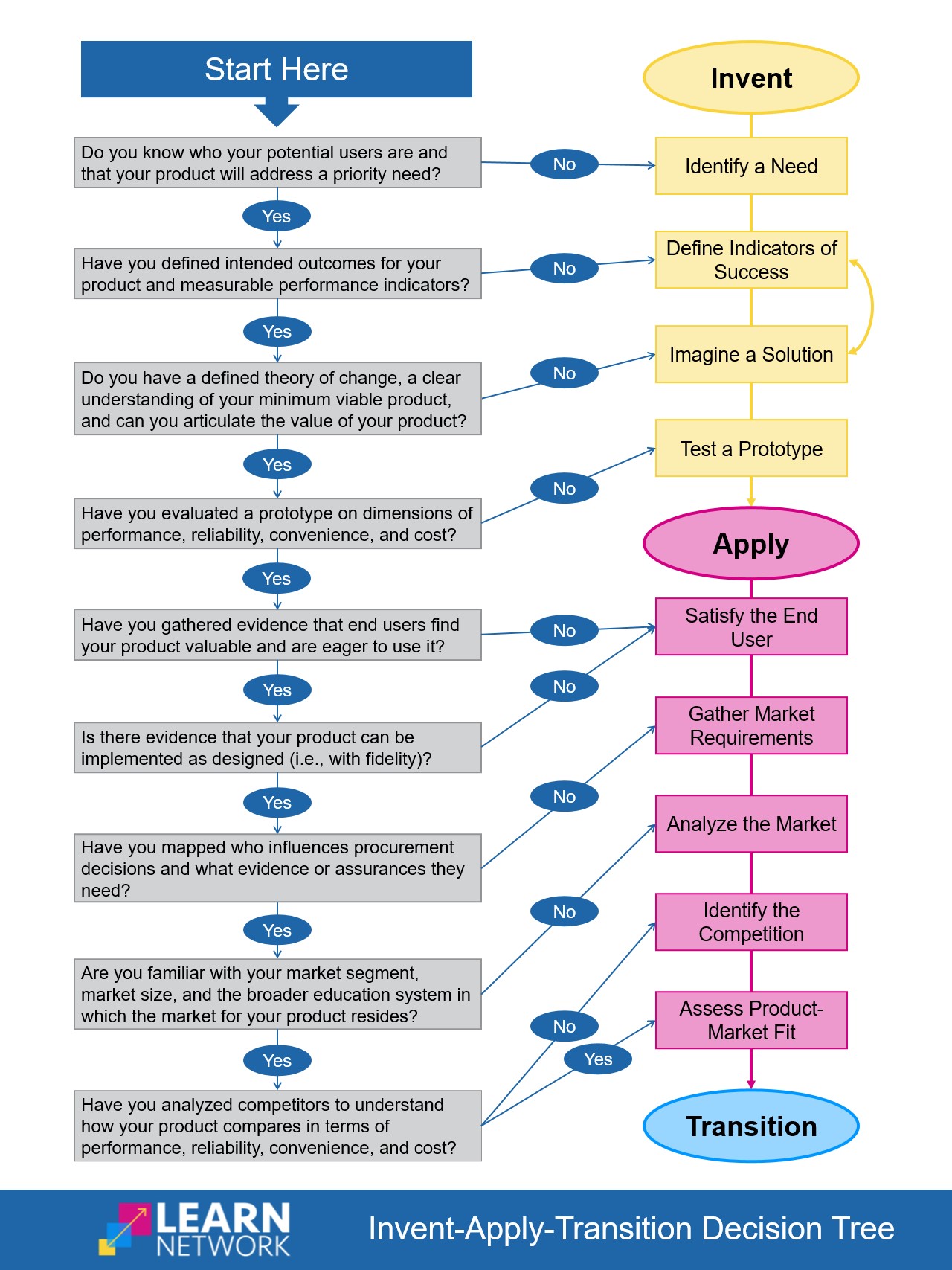
As part of the toolkit, the LEARN Network created a new I-A-T Decision Tree to help R&D teams locate themselves within the I-A-T process and decide what comes next. The tool asks a brief series of reflective questions about your team’s product, users, and evidence base, helping you identify whether it’s time to invent, apply, or transition.
The Decision Tree supports three common needs:
- Finding an entry point and determining where to start if you’ve already begun development.
- Iterating within Invent and Apply and deciding whether to move forward or revisit an earlier step.
- Preparing to transition by assessing your readiness to bring a product to market and scale its use.
By following a simple series of yes or no questions, teams can pinpoint their current phase and assess any outstanding needs before progressing. The questions focus less on whether a task is “done” and more on whether teams have the evidence and insight to move forward with confidence.
How to Use the I-A-T Decision Tree
Use the I-A-T Decision Tree on your own or as part of a team reflection. Start at the top, answer honestly, and follow the paths to identify your stage and next steps. The Decision Tree will continue to offer valuable insights as your product evolves; it’s meant to be flexible and iterative, just like the I-A-T process itself.
Why It Matters
Scaling an education innovation isn’t a straight line. Most successful products evolve through cycles of testing, learning, and refinement before finding their fit. The I-A-T Decision Tree offers a practical way to pause, take stock, and align your efforts with where you truly are in the process.
Explore the I-A-T Decision Tree now.
Access the LEARN to Scale Toolkit here.