

| Overview | Prepare to Scale | Envision Scaled Implementation | Set Scaling Goals | Identify a Pathway | Build Your Team | Go to Market |
|---|
Go to Market
Sustained adoption is the path to impact for your customers and predictable revenue to sustain and improve your product. A go-to-market (GTM) strategy is a roadmap that outlines how you will introduce your product to the market, create awareness, and ensure adoption. The decision to purchase or adopt is only the first step. A strong GTM strategy also focuses on customer education, engagement, and feedback to drive long-term success.
- Find the right customers who match your Ideal Customer Profile (ICP) and Ideal Customer Avatar (ICA).
- Get their attention (awareness) by showing them that your product can solve a problem they care about.
- Convince them to try or buy your product by demonstrating clear value.
- Ensure they adopt and engage with the product so that it becomes indispensable.
- Collect feedback and continuously improve the customer experience to foster long-term loyalty.
Finding the Right Customers
In the Set Scaling Goals section, you learned about defining your ICP and ICA. Now you will use them as essential inputs to your GTM strategy to help you focus your marketing and sales efforts on the most valuable customers. The ICP and ICA are complementary but distinct concepts:
- Ideal Customer Profile (profile level): Defines the type of company or organization that would benefit most from your product or service.
- Ideal Customer Avatar (persona level): Focuses on the individual decision-makers (or key buyers), implementers, and end users within your ICP and their specific needs, goals, and behaviors.
For business-to-consumer (B2C) products, the lines between ICP and ICA are more blurred because the customer and the user are often the same person or very closely linked. The ICP in a B2C model refers to the demographic, psychographic, and behavioral characteristics of the consumer group most likely to benefit (e.g., parents of elementary school students who value education and want to play an active role in their children’s learning experience). The ICA in a B2C model is a more specific and detailed representation of an individual person.
As a best practice, try to identify at least three ICAs to represent the key players involved in deciding to purchase, implement, and use your product. These avatars (or personas) represent the key decision-makers (e.g., university provost, K–12 superintendent, nonprofit executive director), implementers (e.g., faculty, teachers), end users (e.g., faculty, teachers, students), or influencers (e.g., parents, community members) involved in the buying process.
The LEARN Go-to-Market Playbook is a guide to walk you through the process of identifying and targeting your ICP and ICA to focus your marketing and sales efforts on the customers most likely to derive value from your product. By refining who you are appealing to, you can drive greater efficiency and increase your chances of success.
Seven Steps for Building a GTM Strategy
The LEARN Go-to-Market Playbook includes seven steps that can serve as a blueprint to building a GTM strategy ready for activation.
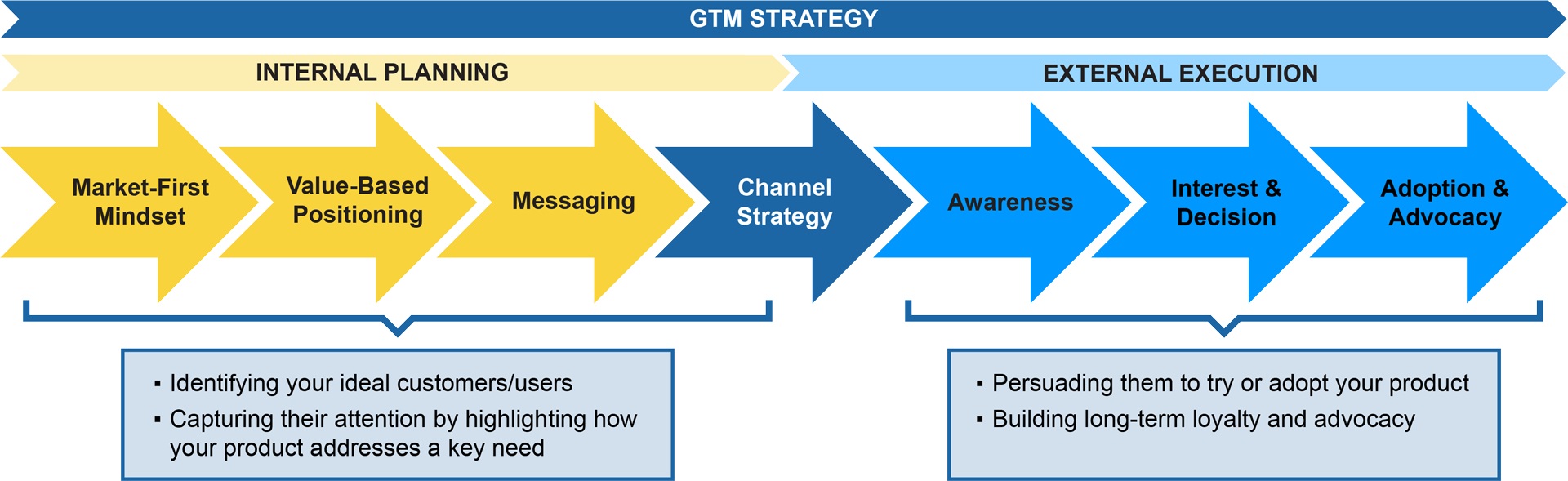
- Build a market-first mindset: Cultivate a mindset focused on the organizations (ICP) and individuals (ICA) best suited to adopt, use, and sustain your product.
- Connect with value-based positioning: Focus your product’s position in the market by narrowing in on how the product addresses ICP/ICA priorities and delivers meaningful results.
- Craft your messaging: Speak directly to your ICP/ICA with messaging rooted in value-based positioning.
- Define a multichannel marketing strategy: Reach your ICP/ICA on their preferred platforms.
- Activate awareness: Activate your multichannel strategy as the first step to getting noticed.
- Drive interest and decision: Drive interest and decision-making, through ongoing engagement between your customers and you and your product.
- Grow adoption and advocacy: Grow adoption and advocacy by turning your existing customers into loyal users who not only stick with your product but also actively champion it to others.
Putting It All Together: A Sample High-Level GTM Plan
Imagine your ICP is a mid-sized research institution that deals with large datasets and struggles with the time it takes to analyze data. Here is a sample GTM strategy:
- Goal: Acquire 100 new customers from research institutions within the next 6 months.
- Messaging: “Cut data analysis time by 50%, allowing researchers to publish results faster and with greater accuracy.”
- Communication and marketing channels:
- LinkedIn to connect with research teams and promote educational content. Potentially invest in paid advertising.
- Email campaigns offering a free demo to decision-makers at institutions.
- Webinars to showcase how your product can solve common research challenges through the voices of your customer advocates.
- Events to meet with prospective customers, engage existing customers, showcase your product, and build more brand awareness.
- Awareness: Create blog posts, case studies, ebooks, and articles about common data analysis challenges in research, targeting academic journals or platforms where researchers are active.
- Interest: Offer a free trial or demo with an easy sign-up process. Highlight time savings and efficiency in your product.
- Decision: Share case studies and testimonials from similar institutions and provide ongoing support through proposals and documentation to help inform a decision.

Stories of Scaling Highlight
The leaders of The Strategic Adolescent Reading Intervention (STARI) learned that organic growth has its limits. Not having the capacity for endless cold calling, they turned their attention to strategic marketing and outreach. They used paid media, such as a successful Education Week webinar that generated nearly 1,000 leads, conference presentations and vendor booths, and an increased social media presence to build awareness. Across these channels, teacher voice and championing of the product have been at the forefront.
Read more of the STARI story of scaling.

Notice and Reflect
While going to market, take time to pause to notice and reflect. Consider the following questions:
- What do I still need to better understand about my ideal customers and the system they are operating in?
- In identifying my ideal customer, what assumptions am I applying? How might this limit my ability to impact educational outcomes?

Spotlight Resource
LEARN Procurement Data Dashboard. This dashboard shares data from a study on how schools make decisions about procuring educational products, including what motivates decision-makers to procure products, who is involved in the decision-making process, and what sources of information they turn to for informed decisions.
Bringing Educational Innovations to Market: Strategies for Developers and Researchers. This virtual workshop underscores the importance of cultivating a market-first mindset when planning for scale and offers a range of practical strategies and resources to support innovators as they navigate the path from development to adoption.

LEARN More
Paid vs. Owned vs. Earned Media: What’s the Difference. This blog post from Harvard Business School Online provides an overview of the different types of digital marketing channels.
Stories of Scaling: STARI. This story of scaling highlights the Strategic Adolescent Reading Intervention (STARI), a literature-focused, Tier 2 intervention for students in grades 6 and up. The story details how the developers pivoted to strategic marketing to grow awareness and adoption.
Email Best Practices. Email remains one of the most valuable channels for communication and marketing. This resource provides best practices to ensure long-term effectiveness, maintain customer trust, and prevent issues such as spam and being blocklisted.
LEARN Network Research Briefs. These briefs share findings from the LEARN Network’s study of school and district procurement, including insights related to strategic marketing, such as what motivates decision-makers to procure products, who is involved in the decision-making process, and what sources of information they turn to for informed decisions.